

You have just cleared Class 12. The challenging phase has concluded, or at least it seems so. Now comes a decision that will shape the next 40 years of your professional life: choosing the right private nursing college in West Bengal.
If you are a student in West Bengal — or a parent sitting across the table trying to help make sense of the options — you already know how confusing the landscape can be. There are dozens of private nursing colleges in West Bengal, all promising excellent education, strong placements, and world-class facilities. How do you separate genuine quality from clever marketing?
This guide was written to answer exactly that question. By the time you finish reading, you will know the six most critical factors to evaluate before you fill out any application form — and you will have a clear picture of what a genuinely strong nursing institution looks like.
1. Why Your Choice of Nursing College Matters More Than You Think
Nursing is one of the fastest-growing and most in-demand professions globally in health care. India alone will need hundreds of thousands of trained nurses in the next decade. The United Kingdom, Canada, Australia, and the Gulf countries are now recruiting Indian GNM and B.Sc. nursing graduates, offering attractive salaries and visa support.
But here’s the thing: not all nursing degrees are created equal. Where you did your studies, how you were trained, and whether your institution is properly recognised by official bodies are three things that will directly determine whether a hospital in Kolkata or a recruiter in Dubai considers you employable.
Students who attend sub-standard colleges often graduate with the right degree on paper but without the clinical confidence, practical skills or institutional credibility that employers expect. Choosing well in the first place prevents that situation.
2. Government Approval and Accreditation: The Non-Negotiable First Step
Before you check out anything else—infrastructure, fees, placement records, hostel facilities, etc – ask one question: Is this college accredited with the right bodies?
If you are looking for a genuine private nursing college in West Bengal, check for recognition from the following three authorities:
- West Bengal Nursing Council (WBNC) – The state-level regulatory body that approves nursing programs in West Bengal.
- Indian Nursing Council (INC)—the national authority that recognizes your degree and makes it valid in all Indian states and acceptable to international employers.
- West Bengal University of Health Sciences (WBUHS)—the affiliating university from which you will actually receive your degree certificate at the end of the program.
If an institution cannot prove all three of these recognitions, then it should be immediately removed from your shortlist, regardless of how impressive their brochure is.
Quick Answer: Your baseline is a WBNC, INC. and WBUHS-affiliated college. Once this box is ticked, all other evaluation criteria follow.
3. Understanding Your Course Options: GNM vs B.Sc. Nursing After Class 12
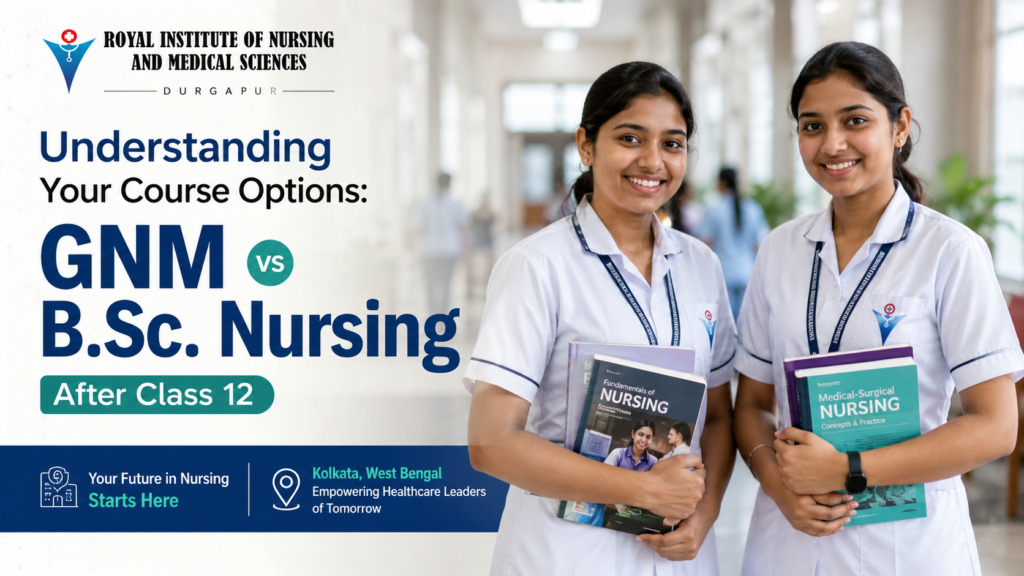
There are two main options available in West Bengal for students seeking nursing admission after 12th. You have to understand the difference before applying anywhere.
General Nursing and Midwifery (GNM) – 3 years
The GNM is a diploma level course which produces good nurses in a shorter duration time. Students complete classroom teaching, laboratory work and clinical postings over three years. The program is particularly strong in maternal and newborn care and general nursing practice. On completion of the course, students can register with West Bengal Nursing Council and get jobs in hospitals, nursing homes, and community health institutions.
Eligibility: Passed 10+2 in Physics, Chemistry, Biology (PCB) and English. Minimum age: 17 years old.
B.Sc.Nursing (Bachelor of Science in Nursing) — 4 Years
B.Sc. Nursing is a full degree program giving you a deeper grounding in the science of nursing, research, and leadership. Graduates have diverse career options including teaching, hospital administration, research and postgraduate study (M.Sc. Nursing). The international recruitment pipelines in the UK, Canada and Australia tend to favour nurses with a B.Sc. qualification.
Eligibility: 12th standard with PCB and a minimum aggregate of 45% (40% for reserved categories) along with a valid JENPAS-UG rank. Minimum age: 17 years old.
Which one to choose? If you want to get into the workforce quickly and cost is a factor, GNM is a solid, respected choice. If your goals are higher—teaching, research or international career – B.Sc. Nursing offers better returns in the long term.
4. Clinical Training Facilities: Where Learning Meets Reality
You can’t learn nursing from books. Clinical skills such as dressing wounds, inserting IVs, communicating with patients and responding to emergencies are learned through repetition in real or near-real settings. That’s why the quality of practical training facilities is one of the sharpest differentiators between good and average nursing colleges.
If you are visiting or evaluating any of the best nursing colleges in West Bengal, ask specifically about the following:
- Is there a hospital attached to the college? One of the biggest advantages is direct access to live patient care on campus, unlike other colleges, which rely solely on external hospital tie-ups.
- What is the nursing lab setup? Look for simulated ward settings, practice mannequins, IV training stations, and equipment similar to what you will be using in real hospitals.
- Are there any government hospital postings? Students are placed in government hospitals where they are exposed to a wide range of real-life nursing needs and work in high-pressure, high-numbers situations.
- Is the library well-stocked and conveniently located? The library is open 24 hours and has current nursing and medical references to promote study outside of class time.
Institutions in healthcare hubs like Durgapur have an additional advantage—the ecosystem around them comprising hospitals, diagnostic centers, and medical professionals provides natural exposure opportunities that smaller towns just cannot offer.
5. Scholarships and Financial Support: Making Quality Education Accessible
Cost is a genuine and valid concern for most of the families who are looking for private nursing colleges in West Bengal. The good news is there is a lot of scholarship support from the West Bengal state government and the central government for those nursing students who are eligible, but only if your college is officially recognised and helps students navigate these schemes.
Nursing students in West Bengal can apply for the following scholarship programmes:
- Swami Vivekananda Merit-cum-Means Scholarship— for students with academic merit and belonging to economically weaker sections.
- Aikyashree Scholarship – For minority community students.
- Nabanna Scholarship — for students from below-poverty-line families.
- Oasis Scholarship – for students belonging to Scheduled Caste, Scheduled Tribe and Other Backward Class communities
- SNA and TNAI Scholarships – professional body scholarships for nursing students studying in recognised institutions.
- WB Student Credit Card Scheme – education loans at low interest rates for students pursuing recognised higher education programmes.
When you look at colleges, ask if they have a strong history of helping students apply for these, and if they’ve had students who have successfully received them. Colleges that provide scholarships to their students show real dedication to accessibility, not simply collecting tuition.
6. Hostel, Safety, and Student Life: Important Factors for Outstation Students
Many students who are applying for nursing admission after 12th belong to different districts of West Bengal—or even from other states. For these students, safe and affordable accommodation on campus is not a luxury. It is a decisive point.
When looking at hostel facilities, don’t just look at the promotional photos. Ask about:
- Security – Is there CCTV monitored 24 hours a day? Is there entry and exit protocols?
- Food quality – Is food being served? Is the kitchen sanitary, and is the food nutritionally adequate for students with physically and mentally demanding schedules?
- Warden support —is there a resident warden for issues happening after hours?
- Medical assistance – Nursing studies are health-focused, so there should be basic medical support on campus.
- Location of academic facilities — Hostels situated on or near the college campus reduce travel time and enhance concentration on studies.
The hostel environment is as important to the parents as the academic program. A safe, structured living environment keeps students focused, healthy, and free from the distractions and dangers of independent living in an unfamiliar city.
7. Placement Support and Career Outcomes: Think Beyond Graduation Day

A nursing degree is an investment. Make sure you know what happens after graduation before you commit to an institution. Ask about whether the college has a formal placement programme, and what the track record is of students actually getting placed.
Mostly the good nursing colleges in West Bengal help the graduates in getting placed in different employment settings like:
- Government hospitals – WBHS, AIIMS, NRS Medical College and other central and state bodies.
- Private multi-speciality hospitals – Durgapur, Asansol, Kolkata and other major metros in the country.
- International nursing careers – the Gulf, UK, Canada and Australia are actively recruiting Indian nurses with recognised degrees.
- Community health, nursing homes and corporate wellness – growing sectors that employ nursing graduates in large numbers.
- Teaching and research (for B.Sc. graduates) – postgraduate study.
When you visit the college or call for an inquiry, ask the admissions team directly about placement data – how many graduates from the last three batches were placed, in what types of facilities and at what starting salaries. A clear, confident answer is a good sign. If you get vague answers, treat it as a red flag.
Royal Institute Of Nursing And Medical Sciences, Durgapur: A Closer Look
Royal Institute Of Nursing And Medical Sciences (RINMS) is one of the most reputed private nursing colleges in West Bengal situated at NH-2 Banskopa, Kanksa, Durgapur, one of the fastest growing healthcare hubs of the state.
Here is how RINMS measures up based on the 6 factors discussed above:
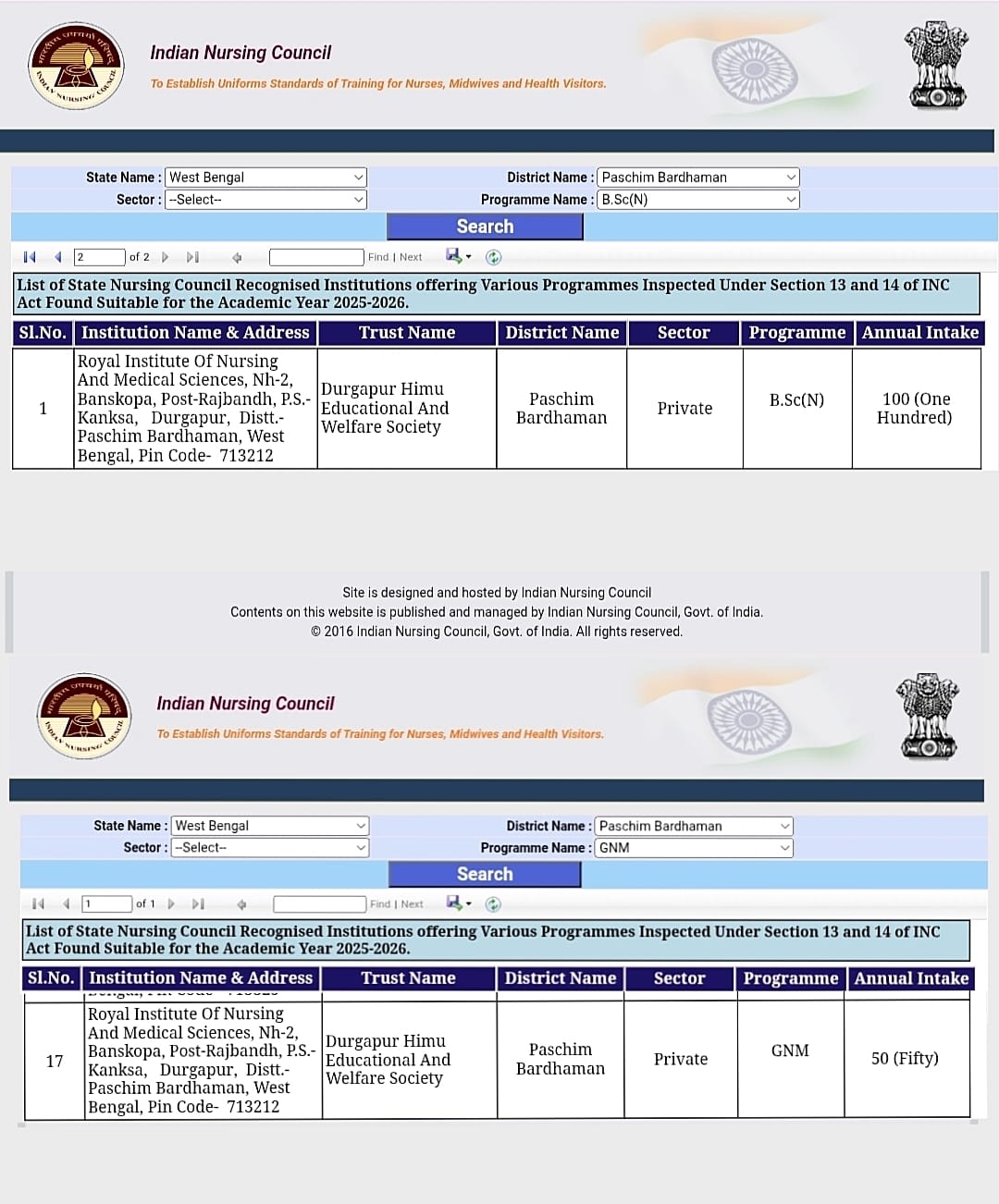
- Recognition: Full recognition by WBNC and INC. Affiliated to WBUHS. The degrees are valid nationally and internationally.
- Courses: GNM (3 years) and B.Sc. Nursing (4 years) available
- Clinical Training: RINMS has its own attached hospital for on-campus patient exposure, and government hospital postings for wider clinical exposure.
- Infrastructure: High-quality nursing labs, smart classrooms with teaching facilitated by projectors, and a modern library that is open round the clock.
- Scholarships: RINMS assists students for Swami Vivekananda Merit Scholarship, Aikyashree, Nabanna, Oasis, SNA, TNAI and WB Student Credit Card scheme.
- Hostel: On-campus accommodation with healthy meals, round-the-clock security, CCTV monitoring, warden support, and medical assistance.
- Placement: Active placement support for government hospitals, private hospitals across Durgapur, Asansol and Kolkata, international nursing pathways.
You can directly contact Royal Institute Of Nursing And Medical Sciences at +91-9735064082 for a personalised walk through the campus and admission process or visit the official website for current admission status, brochure downloads and contact details.
Frequently Asked Questions
Q1. What is the minimum eligibility for nursing admission after 12th in West Bengal?
For GNM, you need to have passed Class 12 with Physics, Chemistry, Biology (PCB) and English from any recognised board. For B.Sc. Nursing same subject requirement is applicable with minimum aggregate of 45% (40% for reserved categories) and valid JENPAS-UG rank. Minimum age for both the programmes is 17 years as on the date of admission.
Q2. GNM vs B.Sc Nursing: Which one is better after 12th?
Depends what you want. The GNM is a 3-year diploma that offers faster employment and is highly respected in all Indian healthcare settings. B.Sc. Nursing is a 4 year degree which leads to higher studies (M.Sc.), teaching and international nursing jobs. If you have clear ambitions around research, leadership or working abroad the B.Sc. is worth the extra year. If the goal is to enter the workforce earlier and cheaper then GNM is great.
Q3. How do I verify that a private nursing college in West Bengal is legitimate?
Get recognition from Indian Nursing Council (INC) , West Bengal Nursing Council (WBNC), and affiliation from West Bengal University of Health Sciences (WBUHS). All three can be verified on their respective, official websites. And before you apply, visit the campus in person, a genuine institution will welcome this and will be open about its facilities, clinical arrangements and placement history.
Q4. Are government scholarships available at private nursing colleges in West Bengal?
Yes. Students enrolled in WBNC and INC-recognised nursing colleges are eligible to apply for schemes like the Swami Vivekananda Merit Scholarship, Aikyashree, Nabanna, Oasis, SNA, and TNAI scholarships, as well as the West Bengal Student Credit Card education loan. The key condition is that the institution must be properly recognised — which is another reason why verifying accreditation before admission is so important.
Q5. Can a nursing graduate from West Bengal work abroad?
Yes. Students studying in WBNC and INC recognised nursing colleges can apply under the schemes like Swami Vivekananda Merit Scholarship, Aikyashree, Nabanna, Oasis, SNA, TNAI scholarships and West Bengal Student Credit Card education loan. The main requirement is that the institution has to be properly recognised – another reason why it is so important to check the accreditation before you enrol.
Conclusion: Make an Informed Decision — Your Career Depends on It
Choosing a nursing school is one of the most important decisions you’ll make as an 18 or 19 year old. The right institution will provide you with recognised qualifications, real clinical skills, financial support in the form of scholarships and a clear pathway to employment – be that working in a Durgapur hospital, a Kolkata medical centre or eventually building a nursing career overseas.
A poor choice – made hastily, on the basis of glitzy brochures or unrealistically low fees – can lead to years of wasted time, invalid degrees or skills gaps that haunt you throughout your career.
Use the six criteria in this guide as your criteria for assessment. First, check for accreditation. Then look at clinical training, scholarship support, hostel safety, placement records and the overall learning environment. Tour campuses. Ask tough questions. And then ask those answering those questions to give you specific, confident, verifiable answers.
If you are looking for nursing colleges in Durgapur, West Bengal, Royal Institute Of Nursing And Medical Sciences (RINMS) is a transparent place to begin. The institution is WBNC and INC approved, WBUHS affiliated and shares its facilities, scholarship support and clinical training structure with prospective students.
Ready to take the first step?
Visit royalnursing.in or call +91-9735064082 to learn about current admissions, download the latest brochure, and schedule a campus visit. Seats are limited – enquire early.
Comments are closed